Edited by Blue Economy Magazine
The Provisional Committee of the proposed Nigerian Coast Guard (PC-NCG) has extended its deepest condolences to the Government and people of Benue State, particularly the families of victims of the tragic boat accident on River Katsina-Ala at Buruku Crossing on Saturday, 3rd October, 2026.
The Committee stressed that maritime safety in Nigeria must move from reaction to prevention, noting that a statutorily empowered Nigerian Coast Guard would enforce compliance BEFORE boarding, not just rescue after tragedy.
In a statement issued by the Director of Communication & Public Affairs, Dr. Piriye Kiyaramo, on behalf of the Chief Executive and Accounting Officer, Capt. Noah Omonu Ichaba, on Tuesday in Abuja, the Committee stated: “Where laws and regulations exist but are not consistently implemented, monitored and enforced, the nation must summon the courage to identify institutional gaps and close them decisively.”

The statement further reads:
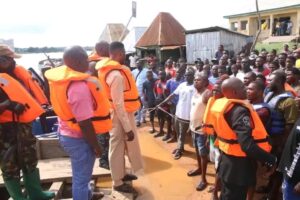
“We mourn those who lost their lives, commiserate with the injured and rescued, and stand in solidarity with the affected communities. We commend the courage of local divers, community volunteers and emergency responders who participated in the search-and-rescue efforts.
This is not a moment for blame, but for sober national reflection. Every life lost on Nigeria’s inland and coastal waters is a painful reminder that maritime safety must never be treated as an afterthought.
While competent authorities must determine the precise cause of the incident, emerging reports raise serious concerns about passenger control, vessel overloading, availability of safety equipment, manifesting, operator competence and enforcement of maritime safety regulations.
The PC-NCG wishes to be unequivocal: We do not claim that the establishment of a Coast Guard would eliminate boat accidents. No responsible maritime institution can make such a guarantee. What a properly established and statutorily empowered Nigerian Coast Guard would provide is a vital layer of civil maritime governance and law enforcement across Nigeria’s inland waterways, coastal waters and maritime communities.”
According to the Committee, the role of the proposed Coast Guard would be fundamentally preventive, ensuring compliance with safety standards before embarkation, rather than merely responding after tragedy.

Basic safety measures, including passenger manifests, compliance with approved carrying capacity, mandatory availability and use of approved personal flotation devices, vessel seaworthiness checks, registration and licensing, safe boarding procedures, operator certification, and strict sanctions against overloading, should never depend on chance or goodwill.
A citizen should not have to board a vessel and simply hope that safety standards have been met. There must be a clearly identifiable statutory authority with the legal mandate, personnel, presence and equipment to inspect, educate, regulate and, where necessary, halt unsafe operations before they become disasters. Safety rules have value only when effectively enforced.
The Katsina-Ala tragedy must compel Nigeria to move beyond a predominantly reactive approach to maritime emergencies. Rescue is indispensable, but prevention is better than rescue, and enforcement is better than condolence.
What Nigeria urgently needs is a coordinated maritime safety architecture in which institutional mandates are clearly defined, jurisdictional boundaries are unambiguous, compliance monitoring is systematic, emergency response is prompt, and accountability is enforceable. Such an architecture must complement, not undermine, the legitimate functions of existing agencies.
Consequently, the PC-NCG calls for: A thorough, transparent and evidence-based investigation into the circumstances of the Katsina-Ala incident, including vessel condition and capacity, passenger numbers, manifesting, availability and use of life-saving appliances, operator competence and regulatory compliance;
Decisive remediation of any regulatory, operational or institutional lapses identified, not merely for this incident but to prevent recurrence; and Intensified safety awareness and education for boat operators, passengers and riverine communities, alongside regular equipping and testing of emergency response systems.

The PC-NCG further calls on the Federal Government, the National Assembly, relevant maritime and inland waterway authorities, State Governments and riverine communities to treat maritime safety as a national imperative, a matter of life and death. The proposed Nigerian Coast Guard should be considered within this broader framework as a statutory institution capable of strengthening safety enforcement, surveillance, search and rescue, environmental protection and maritime law enforcement, in collaboration with existing agencies.
Nigeria does not need another institution for its own sake. Nigeria needs clarity of responsibility, effectiveness of coordination, and enforceability of accountability.
We pray for the repose of the souls of the departed, quick recovery for the injured, and divine comfort and strength for the bereaved families and the Government and people of Benue State.
No Blue Economy Without Blue Security and Blue Justice.